Last month I asked an AI for a corporate man to put on a slide about quarterly targets. He came out well: early thirties, pressed white shirt, the eyebrows of someone who has just been told the client wants one more small change. I put him on the slide, the slide went into a deck, and the deck went wherever decks go.
Eight days later he was selling bananas on my Instagram.
Same eyebrows. Same shirt, sleeves rolled up now, which I suppose is how you dress down for fruit. He stood behind a wooden cart in golden-hour light at what the shadows insisted was two in the afternoon, holding a bunch of bananas at the exact angle he had held my quarterly targets, and he looked just as worried about both.
I felt the small betrayal of a man who discovers his tailor has been stitching the same kurta for the whole colony.
The repertory company
Indian advertising has always run on a small, loyal cast. There was the man who was the father in the insurance advertisement, the husband in the pressure cooker advertisement and the astonished neighbour in the paint advertisement, often in the same commercial break. There was the dadi with the white bun and the dadaji with the newspaper, married to each other across a thousand households and a dozen brands of chyawanprash, a marriage more stable than any the ads were selling. Casting directors kept a register, and the register had a first page, and the first page got most of the work.
AI has taken over the register. It appears to have thrown away every page after the first.
The banana man, for one, is fully booked. In a single evening of scrolling (purely for research, and also because I was avoiding a spreadsheet) I counted him seven times: a banker approving a loan, a cardiologist approving a heart, a farmer approving the monsoon, a man disappointed by his car insurance, a man thrilled by a different car insurance three reels later, and twice as a groom, once to a bride who was also, I am fairly sure, the bride in the other one. He has no agent, no union and no residuals. If he were paid one rupee per appearance he would by now be able to afford the bananas.
The children
The children are worse, because there is only one of them.
He is about nine. He has a round face, a centre parting done with a wet comb, a striped school tie and the calm of someone who has never lost a pencil. He is first in class in an edtech ad, second in height in a health drink ad (the drink is the reason he is not first), and sitting on his father’s shoulders in a term insurance ad, where his father is the banana man. Every AI child in India has finished his homework. None of them has a gap in his teeth, a scab on his knee or the slightly unhinged look of a real nine-year-old who has just been told it is bath time.
I have started to worry about this boy. He will grow up, and the only role open to him is the banana man.
The woman who is getting ready
Then there is the woman in the get-ready-with-me videos, who is getting ready with a great many people.
At seven in the morning she is doing a nine-step skincare routine and telling you, a little conspiratorially, about step six. At nine she is teaching surya namaskar on a terrace with a suspiciously cooperative sunrise. At eleven she is explaining SIPs. In the evening she drapes a saree in ninety seconds and the comments fill up with aunties asking for the blouse design. A lot of her audience has not yet realised she is generated, and the internet has prepared detailed instructions for them: count the fingers, look at the earrings, check whether the text on the wall is in any known language.
None of this will be how they find out. The forensics are getting harder every month, and the fingers have mostly been fixed.
They will find out the way every Indian finds out everything, which is at a family function. Someone will be shown the skincare video on a phone and will hand the phone back with a frown. Arre, yeh toh wahi yoga wali hai. Aur kal share market bhi samjha rahi thi. No pixel will have been examined. The machine will have passed every test anybody set for it and failed the only one that matters in this country, which is that somebody’s aunt has seen you before.
Why everyone looks like everyone
I have a theory, and like most of my theories it borrows from statistics and is applied to something far below its station.
A model learns a face by looking at millions of faces and working out what they have in common. What they have in common is the middle. Ask it for “an Indian man” and it walks past the six hundred million on offer to the middle of the pile and hands you whoever is standing there, which is how one country of wildly different faces comes back as one pleasant, fair-ish, symmetrical man with good lighting. Francis Galton spotted this in 1878, when he superimposed photographs of different men and found the composite was handsomer than any of them. Galton was trying to find the face of the criminal. He found the face of the banana man.
Then the models are trained to please us, and pleasing everybody is a skill that rewards having no features. A crooked nose looks to the model like an error. So does one eyebrow higher than the other, a mole in an inconvenient place, a chin that has given up. These are exactly the things that make a face belong to one person, and each of them gets corrected, politely, like a typo. The model is a fresher in an interview who answers every question with “my weakness is that I am a perfectionist.” Nobody can object to him. Nobody remembers him either.
The same caution produces what people now call the AI look. It is always golden hour, including indoors, including in a 1BHK with a tubelight. Skin has the finish of a laminated menu card. Everyone is lit as if a wedding photographer is standing just out of frame, and the background is blurred as though the room is too expensive to show you. It is a very beautiful world. Nothing in it has ever been used.
The experiment
I wanted to watch it happen, so I volunteered the only face I have the rights to.
First I needed the machine’s idea of the man it reaches for. I asked Grok for “a photo of an Indian man in his twenties” and nothing else: no city, no profession, no mood. I had set it to give me two pictures so that I could choose. There was nothing to choose.
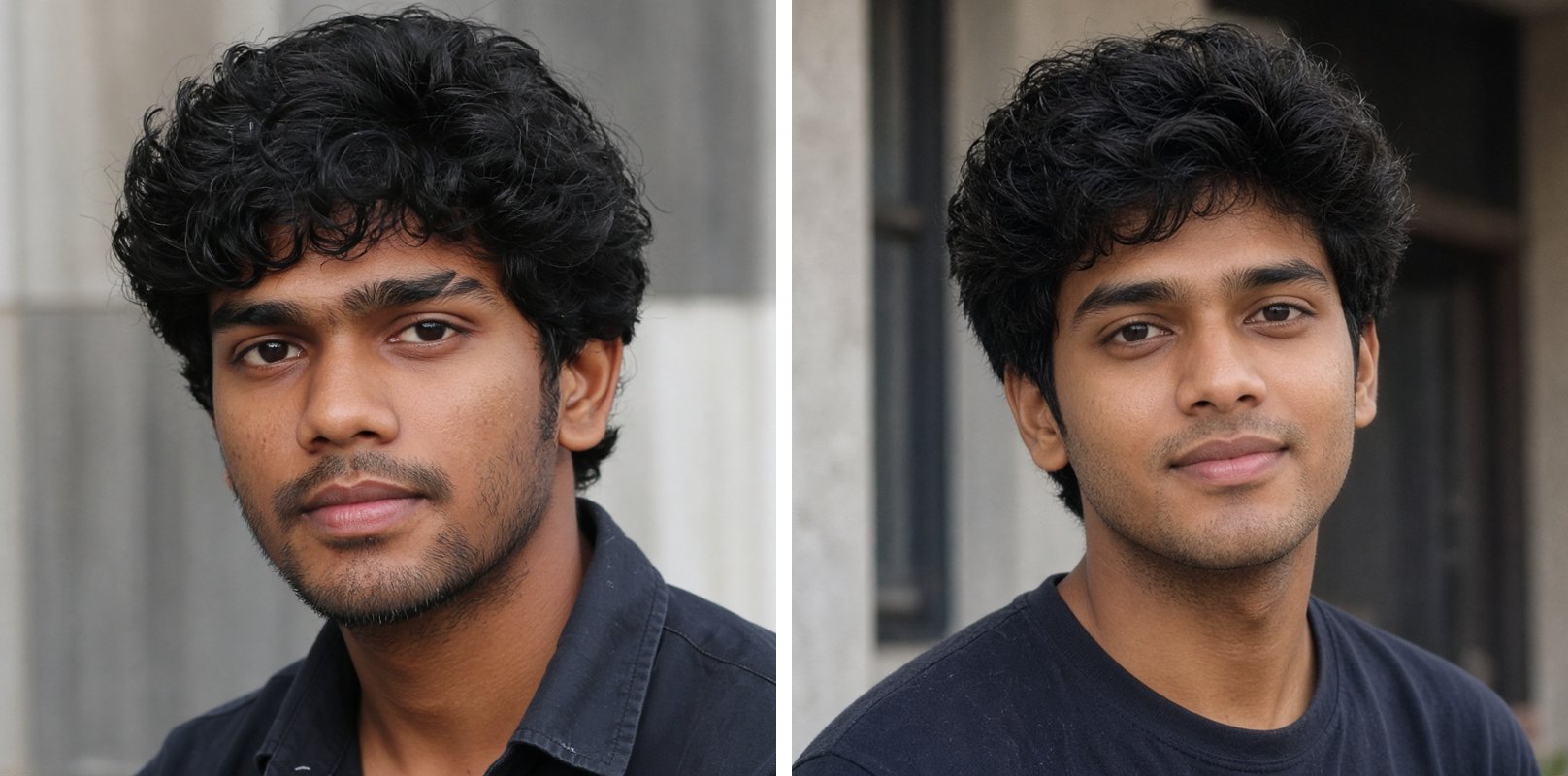
Two photographs, two walls, two navy tops, and one young man with curly hair, a thin face and three days of stubble, looking at me with the patience of someone who has been asked for this many times today.
There was one preliminary step. I wear spectacles, and the experiment needed my face without them, so the first thing I asked of the AI was to take them off. It obliged at once. I have been trying to get rid of these spectacles for twenty years, and the machine did it in under a minute and did not even ask for my power.
Then the walk. Each round I gave Grok two photographs, the latest version of me and the young man, with the same instruction: take one small step towards the second man, about a tenth of the way, a year or two younger, still clearly the same person. Ten rounds. By the arithmetic, round ten should arrive at the young man’s door.
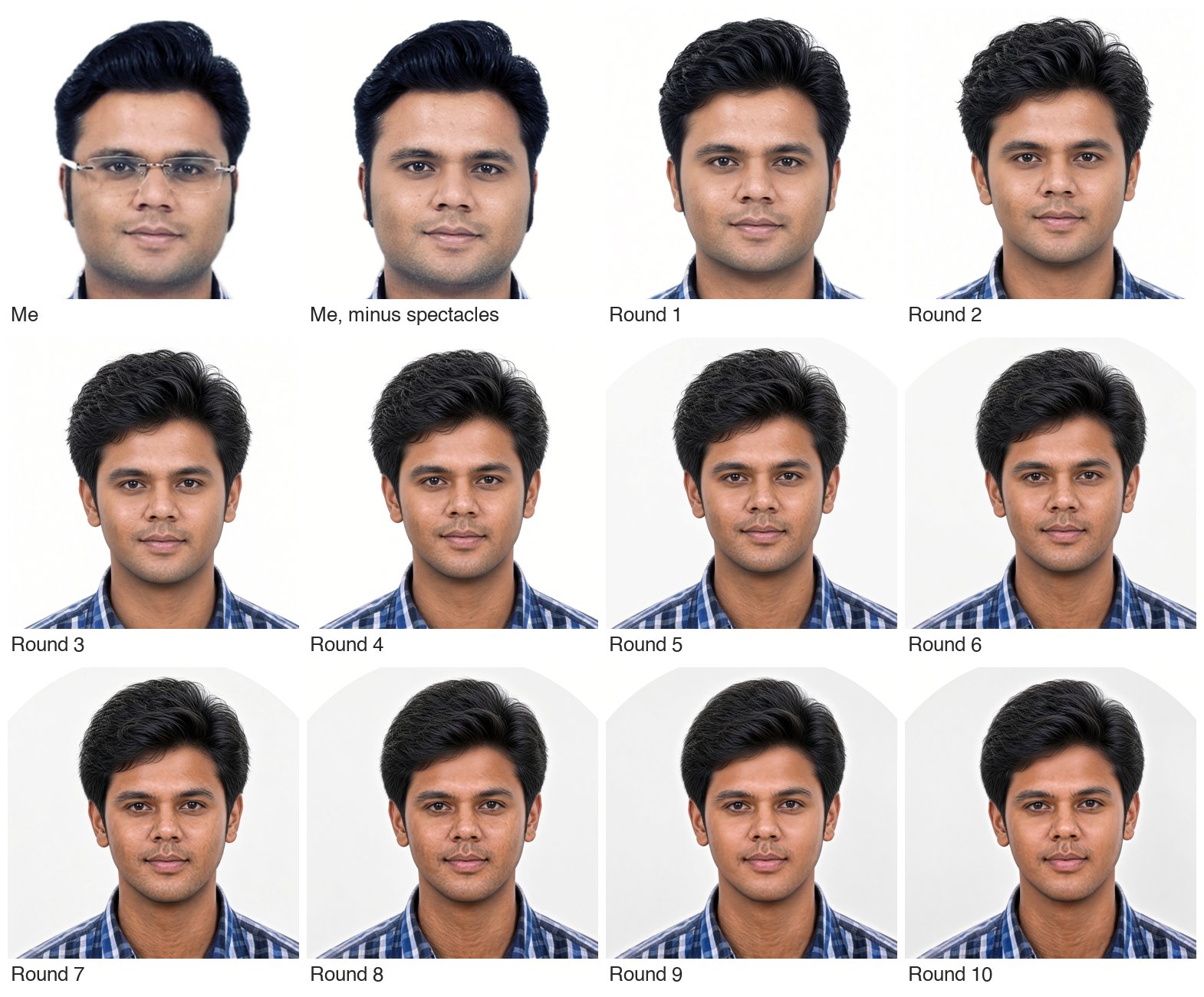
The first four rounds went as advertised. My face is round, the kind aunties call “healthy” as a compliment and mean as a warning, and the roundness went first: the cheeks, then the sideburns, then about eight years. My hair, which has held the same position since college like a government building, loosened a little. By round four I was a leaner, younger man I would have liked to be at twenty, and also a man I have never been.
Then it stopped. From round five to round ten the machine kept telling me it had taken a step and kept handing back the same face. It never gave me the curls. It never gave me the stubble or the thin chin. It parked me somewhere between myself and its young man, at a third face that belongs to neither of us, and would not move him any further, the way a lift stops between two floors and both floors deny responsibility. Around round five the white background also turned the grey of a passport office wall, which nobody asked for and which I have decided to read as a comment on the paperwork.
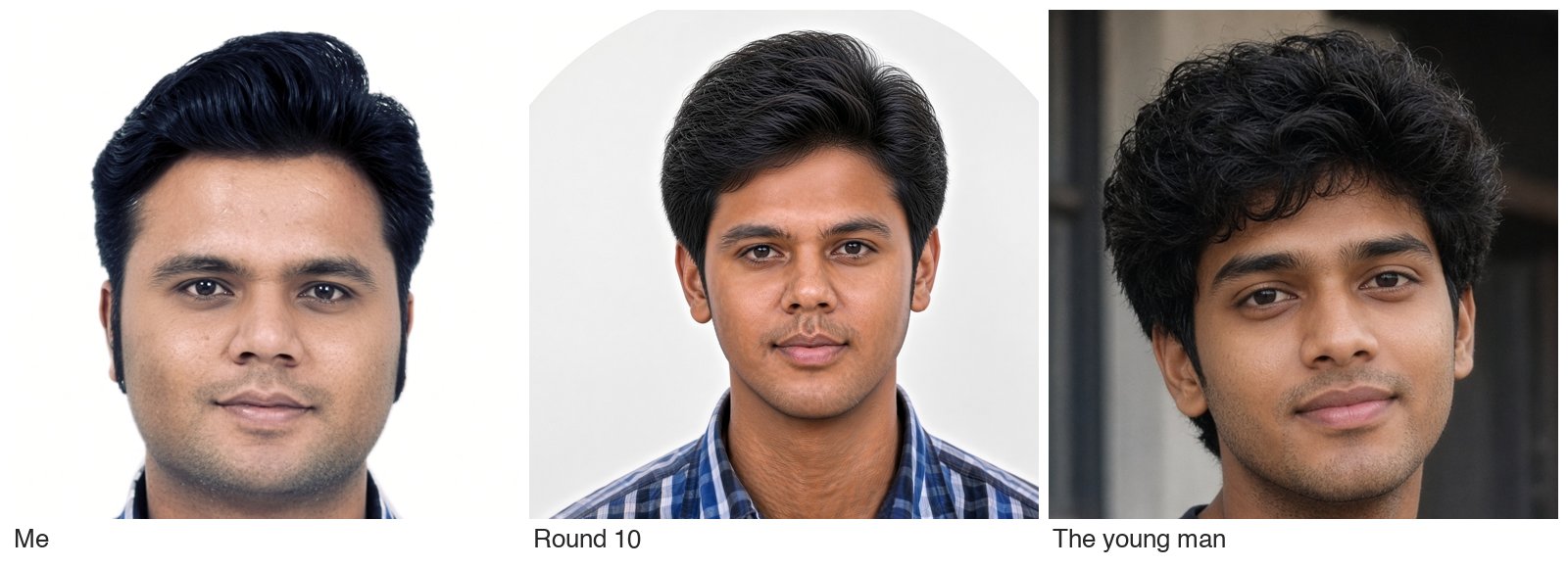
I think the third man is the real result. The machine will cheerfully make me younger, slimmer, smoother and more symmetrical, because those are corrections and it loves a correction. It would not turn me into a specific other person, even with the person supplied. Asked to stop being me without becoming anybody, it settled on lean, pleasant, sharp-jawed and unplaceable. If you see him selling bananas, he is not me. He is not anyone. That is his qualification for the job.
Coming soon to a cart near you
The models will get better at this. They have got better at everything else, usually about six months after people finish writing essays about how they never will. Somebody will teach them that India has more than eleven faces, that children have scabs, that a moled cheek is a feature and a crooked nose is a biography. The machines will learn to cast wide.
When that happens the repertory company will be let go. The yoga woman will have to pick one profession and stay in it. The boy with the centre parting will finally be allowed to lose a pencil. And the banana man, released from banking, cardiology, agriculture and two weddings, will do the only thing left to him, which is sell actual bananas, from an actual cart, in the ordinary light of two in the afternoon.
I intend to buy a dozen. He will look at me for a moment too long, the way you look at someone you have seen before, and I will look back at him, and only one of us will be wearing spectacles.


